The Standstill: Anatomy of a Total Economic Freeze (Part 1)
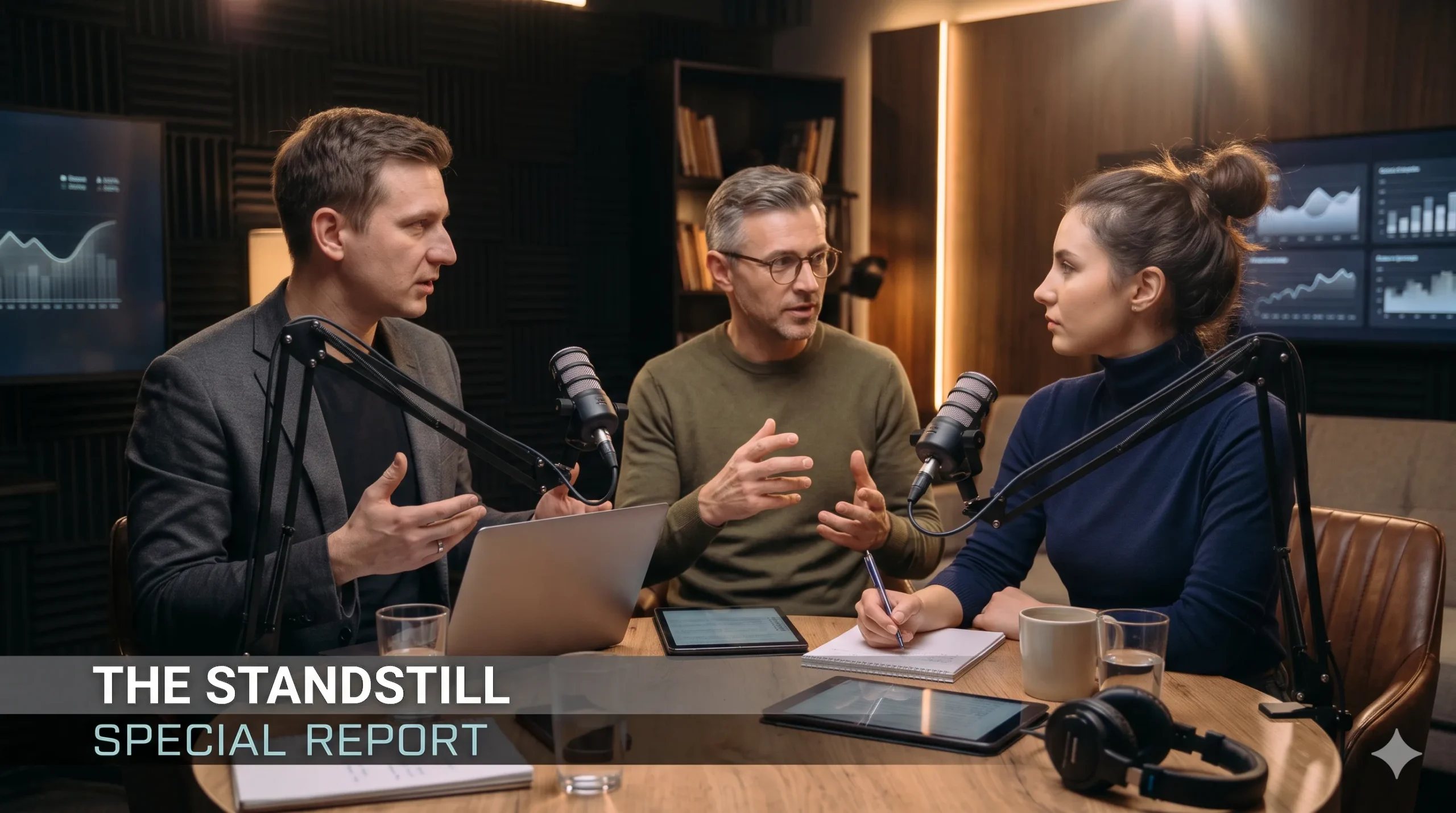
Listen to this breakdown
AI-generated British narration · Read along at your own pace.
At a glance
What began as an isolated industrial negotiation impasse has rapidly cascaded into an economy-wide logistics gridlock, driven by unbacked automated logistical framework mandates and liability shifts rather than surface-level wage disputes.
Special Report | Deep Dive
By Alex (Anchor), Elena (Analyst), and David (Policy Specialist) • 8 min read
Executive Overview
What began on day one as an isolated industrial negotiation impasse has rapidly cascaded into an economy-wide logistics gridlock. Inland freight arteries, intermodal rail yards, and oceanic container hubs have dropped into single-digit throughput efficiency. Mainstream coverage often portrays these standstills as brief, isolated strikes; operational data indicates the exact opposite.
Our panel convened for an emergency briefing to unmask the hidden structural flashpoints, document the cascade through critical supply corridors, and map the immediate fiscal exit ramps.
Act I: The Real Structural Trigger
Mainstream coverage continues to fixate on surface-level wage negotiations. While headline compensation is a major talking point at the press table, the real catalyst sits buried deep within new regulatory automation directives.
🎙️ Alex (Host):
“Let’s skip the cable panic and look straight at the balance sheets. The public was told this was a standard dispute over compensation packages and cost-of-living tiers. Elena, you analyzed the operational filings across the port and rail federations. Where did the real collapse begin?”
📊 Elena (Lead Analyst):
“Wage disputes are just the public-facing smoke screen, Alex. The flashpoint was the unbacked automated logistical framework mandate. Regulators required deep-water port systems and regional intermodal yards to enforce automated processing protocols—without providing capital offset reserves. Crucially, that framework shifted all operational liability for hardware delays directly onto independent third-party transport operators.”
🎙️ Alex (Host):
“In plain English: whenever automated sensors stall or processing bottlenecks occur, the independent haulers pay the penalty fee, while operational margins disappear.”
📊 Elena (Lead Analyst):
“Precisely. When continuing to run your equipment guarantees net operational losses per freight ton, parking the trucks is no longer merely a protest—it is basic balance-sheet survival. That is what triggered this sudden halt.”
Act II: The Failure Cascade Across Inland Arteries
Once movement ceased along initial arterial transit nodes, just-in-time delivery assumptions broke across key sectors within 72 hours.
[Port & Intermodal Yard Stoppage]
               │
               ▼
   (Inland Hub Dwell Reaches 94%)
               │
               ▼
 [Rail Corridors Physically Blocked]
               │
               ▼
[Regional Cold-Storage & Fuel Runouts]
🎙️ Alex (Host):
“Bringing David into the room. David, you spent fifteen years advising transport boards on trade resilience. Cable networks are calling this a two-week headache. What does your modeling say?”
🏛️ David (Policy Specialist):
“Two weeks is an illusion, Alex. Modern inventory systems operate on strict just-in-time logistics. They have zero surplus cushion. Look at the primary freight corridors: inland transfer hubs are already operating at 94% dwell capacity. If freight does not move within 96 hours, intermodal containers physically lock the rail tracks.”
📊 Elena (Lead Analyst):
“And the moment rail tracks lock, localized municipal supplies take the hit. We’re talking basic cold-chain transport: dairy, refrigerated produce, and refined fuel shipments.”
🏛️ David (Policy Specialist):
“Right. It ceases being an abstract corporate negotiation and lands squarely on supermarket shelves and neighborhood fuel stations. That is when public panic overtakes the balance sheets.”
Act III: The Exit Ramp & Next Steps
A resolution cannot be achieved through ideological stubbornness. An operational compromise requires concrete fiscal and regulatory adjustments before the 90-day window closes.
🎙️ Alex (Host):
“Let’s focus on the actionable exit ramp. Neither side is budging in public. How does this actually resolve without total federal preemption?”
🏛️ David (Policy Specialist):
“It requires an immediate three-step mechanism: First, a provisional 90-day administrative freeze on all automated liability transfers. Second, an emergency federal backstop covering operational insurance surcharges. Third, emergency binding arbitration with a mandated deadline.”
📊 Elena (Lead Analyst):
“And the leadership must swallow the reality that retrofitting supply networks comes at an immediate capital cost. You cannot mandate modernization while pretending the freight sector can absorb it without inflation.”
🎙️ Alex (Host):
“In short: stabilize the corridors, shoulder the interim transition costs, and get wheels turning before the consumer distribution chain collapses.”
📌 Key Takeaways for Observers
-
Root Factor: The conflict is driven by liability assignment under new automated terminal regulations, not base wages.
-
Immediate Risk: Inland transfer hub lockups threaten critical fresh food, dairy, and regional fuel supplies within days.
-
The Fix: A 90-day regulatory stay alongside structured federal arbitration offers the only realistic path out of total disruption.
Community Discussion & Part 2 Preview
Where do you stand? Is David’s compromise realistic, or will the gridlock win? Leave your analysis in the comments below.
🔔 Stay tuned: Part 2 drops tonight, breaking down the 90-day clock and exactly who holds the leverage to break the deadlock.
Watch the daily 50-second studio rundown on YouTube: @BreakdownDailyUS
Topics: Economy · Logistics · Regulations · Special Report · Supply Chain
Join the discussion
Share your thoughts or ask a question. Comments are checked for spam and reviewed before appearing. Your email address will not be published.